
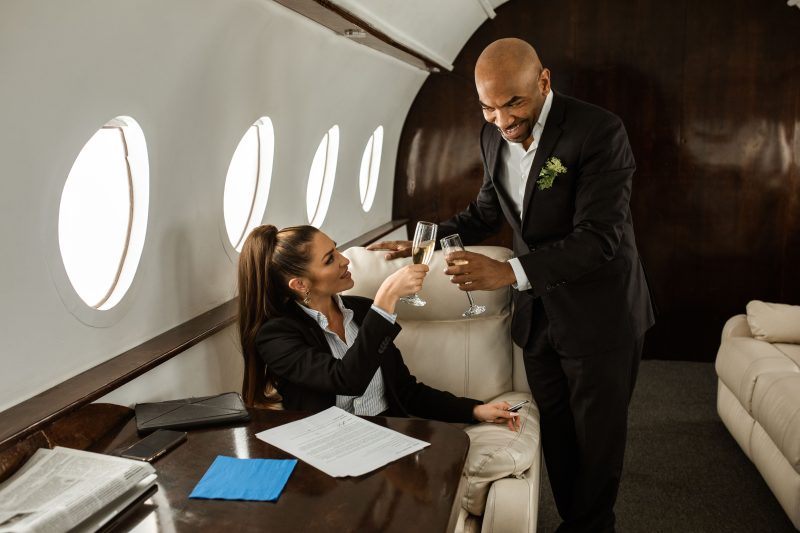
A private-equity partner lands in Munich on a Tuesday night for three days of meetings. He has a suite booked, a driver on call, and absolutely no interest in opening Hinge.
Not because he isn’t interested in company, but because the last time he tried, he spent forty minutes messaging someone who cancelled twenty minutes before dinner, with no explanation and no way to get that evening back.
For a man whose hourly rate runs into four figures, that is not a minor inconvenience. It is a bad trade.
This is the quiet story behind a shift that has been building for a couple of years now: financially comfortable, frequently traveling people increasingly paying for arranged company rather than gambling on an app.
Some are booking professional matchmakers. Others, especially when the need is a single evening in an unfamiliar city rather than a life partner, are booking companions and escorts directly. Both are symptoms of the same diagnosis: the apps were never built for people whose time is the scarcest thing they own.

The problem was never a shortage of matches
If you have money and a decent set of photos, getting matched isn’t the hard part. The apps still do that reasonably well. The trouble starts about ten seconds later, in the part nobody really designed for: the fade, the flake, the plan that never firms up.
According to a Forbes Health/OnePoll survey cited by Elle’s 2026 reporting on luxury matchmakers, 78 percent of people report some degree of dating app fatigue. That is not a niche complaint anymore; it’s close to the median experience.
For an ordinary user, a wasted evening is annoying. For someone billing hundreds of euros an hour, or running a five-city week, it is closer to lost revenue.
Match Group has reported eight consecutive quarters of declining Tinder subscriptions, and industry data from 2026 shows the broader dating-app market contracting for the first time on record, with average session length down roughly 13 percent year over year even as the cost of acquiring a new user has nearly doubled.
People are not spending less time on the apps because they found someone. They are spending less time because they are tired.
There is also a verification problem that gets sharper the more recognizable you are. A profile sitting on a mainstream app for a fortnight can be screenshotted and passed around a group chat before the first drink is poured, which is exactly why people whose names are attached to a company, a fund, or a public role quietly stop putting themselves on there at all.
Wealth doesn’t make dating easier. New research says it makes it harder
Here is the part that surprises people who assume money solves everything: it makes this particular problem worse, not better.
Third-party panel research commissioned by the Chicago matchmaking firm Selective Search and published in July 2026 found that 72 percent of ultra-high-net-worth single men say their financial success has made finding a genuine partner harder, and 41 percent cite not knowing whether someone is interested in them or their bank balance as their single biggest dating challenge.
That statistic reframes the whole conversation. The appeal of a booked, priced, contractually clear arrangement with a companion isn’t that it replaces intimacy with commerce.
It’s that it removes the guessing game entirely. Nobody has to wonder what the other person actually wants, because the terms were agreed before anyone got in a car.

What’s actually being purchased: time, and the absence of ambiguity
Strip away the marketing language on either side of this market and everyone is selling the same two things in different proportions: time, and discretion.
Time is the one you genuinely cannot buy more of. An evening arranged by someone who already knows what you want, with a person who has already agreed to be there and be on time, costs money.
An evening spent messaging three matches who never show up costs a different kind of money, and nobody sends an invoice for that one, though the opportunity cost is real.
Luxury Lifestyle Magazine’s August 2026 analysis of this shift put it plainly: paying to skip the queue, get the table, or be on the list for the thing nobody has posted about yet reads as ordinary lifestyle spending everywhere else in a wealthy person’s life.
Nobody has ever felt the need to justify that over dinner. Dating is the one area where people still act surprised that the same logic applies.
Discretion is the other half, and for a certain kind of traveler it matters more than the introduction itself. You already pay for privacy in how you fly, who manages your money, and what does or doesn’t end up on a feed.
It would be strange if your evening plans were the one place you simply accepted exposure. This is precisely why high-end companion agencies built their entire operating model around confidentiality long before a matchmaking app thought to put an NDA in its onboarding flow.
Professional agencies in cities with heavy business-travel traffic, including escort München services that regularly work with executives passing through for trade fairs and client dinners, handle the logistics end to end: hotel coordination, scheduling, discretion around bookings, the sort of arrangement management an executive assistant would normally run.
Three ways to buy your way out of the apps, compared

None of these are the same product, and conflating them is where most casual conversations about this topic go wrong. Here is what each one actually is, roughly what it costs, and what it’s built to solve.
| Option | What it’s actually for | Typical cost | Discretion level |
|---|---|---|---|
| Mainstream dating apps | Self-directed volume dating; you do the filtering and the arranging | Roughly $30/month (Hinge) up to $500/month for top-tier subscriptions (Tinder) | Low; profiles are searchable and screenshottable |
| Elite matchmaking firms | Curated introductions aimed at a committed relationship, vetted by a human | From a few thousand dollars into six figures per client (e.g., Bonnie Winston’s NYC practice) | High; NDA-based and off-platform |
| Companion/escort agencies | A single arranged evening, trip, or event with no ambiguity about intent | From roughly €900 for two hours to several thousand euros for multi-day travel, per one Munich agency’s published 2026 rate card | Very high; built around anonymized bookings and verified logistics |
The thing worth noticing in that table is not the price gap, which is obvious. It’s that only one of the three rows removes ambiguity entirely. A matchmaker still requires two people to genuinely like each other after the introduction.
An app requires that and a great deal of luck besides. A booked companion arrangement is the only one of the three where the evening’s shape is agreed in advance, which is exactly why it appeals to people whose real complaint about dating apps was never a shortage of options.

“There’s a huge difference between a dating app and someone who gets to know you”
Adam Cohen-Aslatei, CEO of the matchmaking service Three Day Rule, drew that line clearly in comments reported by Bloomberg and picked up by Global Dating Insights in 2025: a dating app is “self-selected, filter your way into perfection, a wild wild west,” while matchmaking involves someone who actually gets to know you.
His firm reported its strongest sales month in fifteen years despite a broader pullback in luxury spending, which tells you something about how non-negotiable this category of spending has become for the people who use it.
That quote is usually used to defend matchmaking specifically. I’d argue it applies just as well, maybe better, to booked companionship, because the “getting to know you” problem an app can’t solve isn’t really about compatibility scoring. It’s about knowing, walking in the door, exactly what kind of evening you’re both there for.
The honest counterargument, and where I land on it
The obvious objection deserves a real hearing rather than a dismissal: paying for company, in any form, substitutes a transaction for the vulnerability that makes connection meaningful in the first place.
Critics of the premium matchmaking boom make a version of this argument too. In the Elle piece cited above, one client who paid several thousand dollars for a matchmaking package and didn’t find a lasting relationship put it bluntly: “It’s a lot of money for a boyfriend.
It’s weird.” That discomfort is legitimate, and it applies with even more force to paid companionship, where the arrangement is explicit rather than aspirational.
My honest view is that this objection assumes everyone buying into this market is looking for the same thing a matchmaking client is looking for, and that assumption is simply wrong.
A founder flying into a city for four days of investor meetings who books an evening of company is not shopping for a spouse and failing to find one honestly; he is solving a specific, bounded logistics problem, the same way he’d book a car service instead of learning the metro.
Judging that transaction by the standards of a marriage market misreads what it’s actually for.
Where I’d push back on the industry itself is different: agencies that are vague about pricing, consent, or legal status deserve exactly the skepticism critics bring to the whole category, and reputable operators publish their terms for precisely that reason.

Where the money actually goes on a booked evening
Reputable agencies now publish rate cards rather than leaving pricing to a private message, which is itself a discretion and trust signal; a client can decide before any contact is made rather than negotiating in the moment.
One Munich-based agency’s 2026 published rates run roughly €900 to €1,800 for a two-hour booking depending on category, scaling to several thousand euros for a full day or a multi-day trip, with transparent surcharges for travel distance and additional guests listed upfront.
That kind of published, itemized structure is precisely what a matchmaking client is also paying for when a firm charges tens of thousands of dollars: not the company itself, but the certainty of terms agreed before anyone shows up.
What this actually says about the apps
None of this means dating apps are finished, or that everyone with money has abandoned them. Most people, wealthy or not, are still on Hinge or Bumble and still meeting people that way.
What has changed is the frequent traveler’s calculation. If your week is genuinely built around four cities and back-to-back meetings, the return on hours spent swiping toward an uncertain outcome looks worse every year, and the return on a single, clearly arranged evening looks correspondingly better.
The broader matchmaking data backs this up at scale: premium, human-led services are growing at close to 9.5 percent annually even at a price point 100 to 1,000 times an app subscription, according to the same 2026 industry analysis.
People are not choosing to date less. They’re choosing to pay for certainty over volume, and companionship bookings are simply the most literal version of that same trade.

How this article was put together
This piece drew on 2026 reporting and research from Elle, Bloomberg (via the Union Democrat), Luxury Lifestyle Magazine, Global Dating Insights, and a July 2026 third-party panel study commissioned by Selective Search LLC, all checked in August 2026.
Pricing figures for companion bookings came from a Munich agency’s own published 2026 rate card rather than a secondhand estimate.
Matchmaking success rates cited by firms in the source articles are self-reported and not independently audited, so they’re presented here as directional rather than precise.
Prices and rate structures in this market change; anyone comparing options should check current published rates directly rather than relying on figures in this article after a few months have passed.